Description
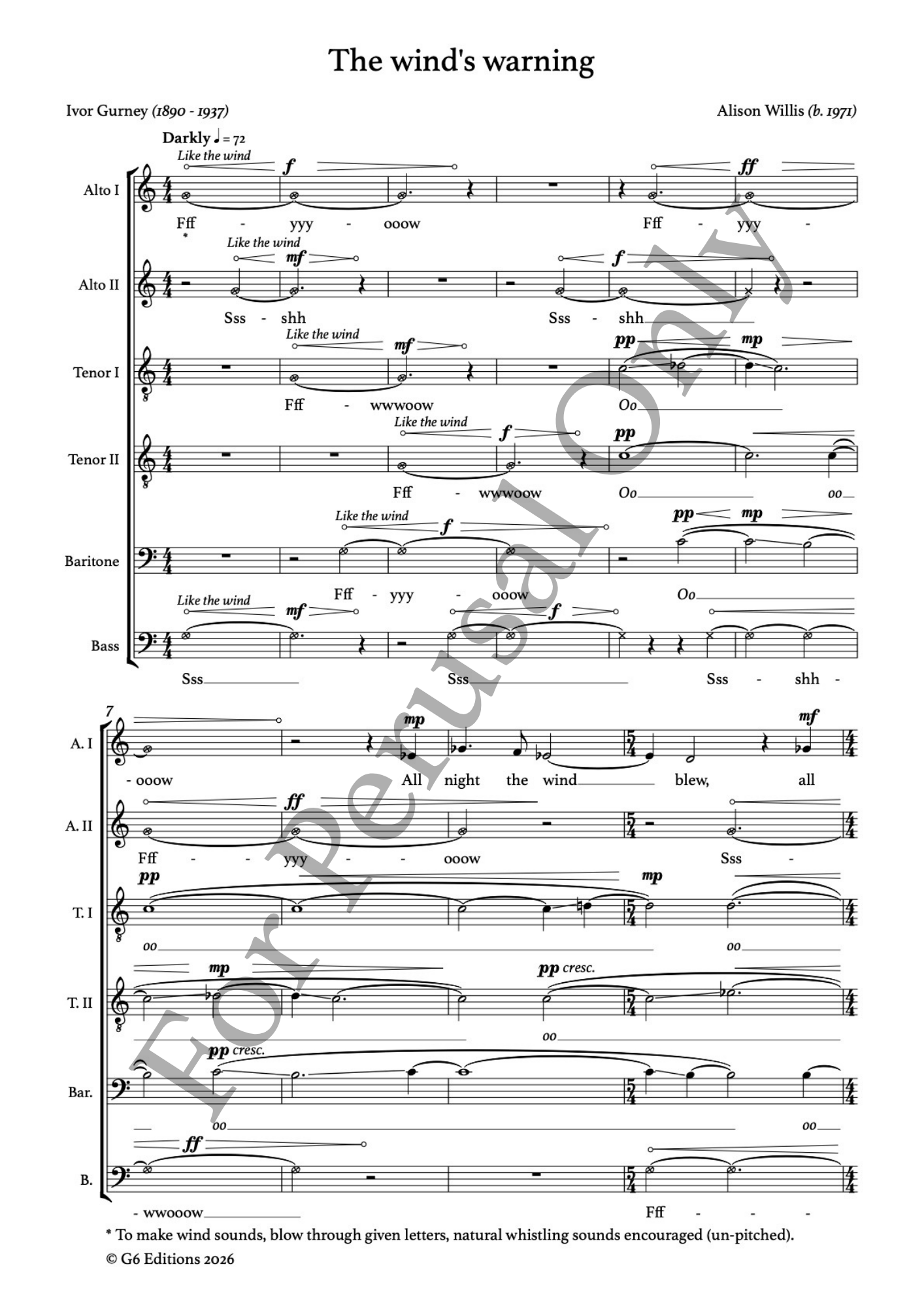
The wind’s warning by Alison Willis was the winning entry in the 21-and-over category of The Gesualdo Six’s second composition competition. Willis set The Wind, believed to be the final poem written by Ivor Gurney. According to the editor of the collection in which it appears, the poem was penned on the back of an Oxford University Press letterhead, dated 6 March 1929 and signed ‘Valentine Fane’—one of the many pseudonyms Gurney used in his later manuscripts. The text is a stark meditation on the flow of time and lost opportunities. Willis’s setting evokes the poem’s restless atmosphere through delicate vocalisations that suggest the wind itself, layered over dissonant clusters that shift and shimmer. Melodies drift in and out like fleeting gusts until the middle section, ‘At dawn a thin rain wept’, where the music opens into a more lyrical space. The work then gradually returns to the original wind-laden soundscape, closing as it began, with an almost imperceptible sigh. The piece is a miniature of tension and release, capturing both the fragility and the persistence of memory.
© Owain Park 2026
All night the wind blew—
All night the fierce wind blew—
All night I knew
Time, like a dark wind, blowing
All days, all lives, all memories
Down empty, endless skies—
A blind wind, strowing
Bright leaves of life’s torn tree
Through life’s eternity:
Dreadfully swift, the Time blew.
All night I knew
The outrush of its going.
At dawn a thin rain wept.
Worn out, I slept
And woke to a fair morning.
My days were amply long, and I content
In their accomplishment—
Lost the wind’s warning.
Ivor Gurney (1890 – 1937), The Wind